
Set Review: 42218 John Deere 1470H Wheeled Harvester
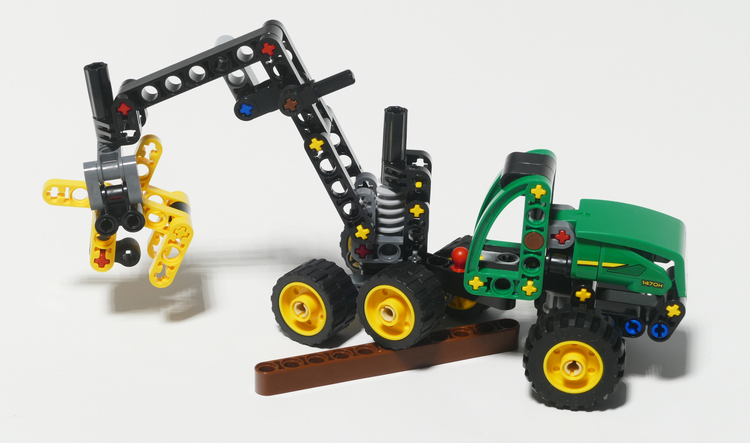
We all love building spectacular flagship Technic sets with part count in multiple thousands and building steps in many hundreds, but small Technic sets do have their own particular charme, too. Achieving interesting functionalities while constrained by barely more than a hundred parts, and by the size that typically has to fit into a coat pocket, requires plenty of ingenuity and clever minimalism. I enjoyed, hence, the opportunity to check out the new and upcoming 42218: John Deere 1470H.
Trucks and tractors capable of hoisting timber aren't unseen so far in the LEGO world. I myself bought, back then when it hit the market, the nice pneumatic-powered 8049 Tractor with Log Loader, but missed on thee earlier 6443 Pneumatic Log Loader at the time it appeared in the mid-90's. This one is much smaller than both, and backed by a license from John Deere—as it is based on the Illinoisan giant's real harvester.

Seasoned builders will find assembling 42218 a rather simple and short affair. It relies on standard Technic linkage techniques for the engine compartment and for the cabin, but it is the log hoist that attracts the most attention. It can be rotated around vertical axis (on a friction pin, since anything more advanced would have been infeasible at this scale), its primary arm lifted via a worm screw, and its secondary arm swiveled on a friction pin through a lever and what is probably the tiniest parallelogram linkage ever.

The grabber at its end, connected with an axle and relying on gravity to always point downward, can be rotated along its own axis too, and its claws moved individually to grab an object—specifically, an eleven-stud long brown Technic beam representing a log. The section supporting the hoist has four wheels on two bogies, allowing it to clear modest bumps, whereas the pin connection to the cabin and engine ensures it does not just swing around freely.

As said, getting all these functions with just 117 parts, along with the underlying chassis and bodywork, is a nice example of what makes small good Technic sets such. Of course, not everything can work perfectly smoothly at this scale: the bogies are attached with friction pins which makes them slightly stiff (whereas using frictionless pins would have made them too flimsy). The vehicle is also prone to tipping when the hoist is fully extended and rotated sideways, but from my building experience, these are the types of compromises one simply cannot evade when building at such small scale.
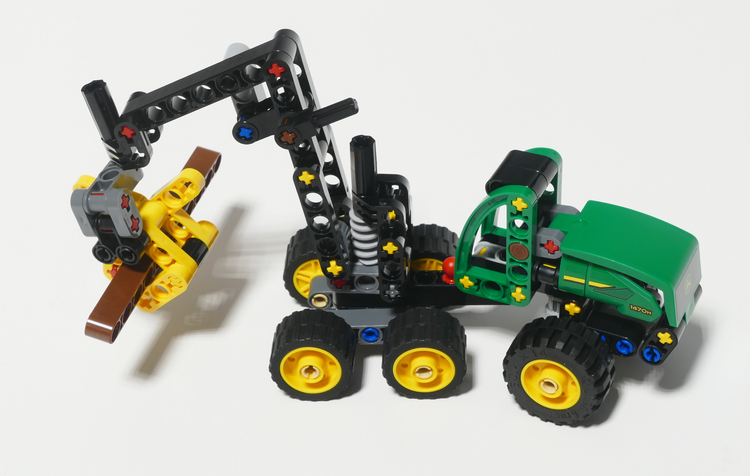
Which is not to say this set could not conceivably be better. While it works, I found representing a log with a brown Technic beam a little unsatisfying. If one intended to stay within the Technic parts set, five brown or reddish brown pin connectors (62462) connected with four friction pins would have looked better. And outside Technic, there is an abundance of available existent parts intended to represent logs.
Five stickers is not a painful amount, and were possibly mandated by John Deere to ensure recognizability. Also, the real harvester's cabin is attached to the front, not the rear section, but that is not a major worry here—it would have made the model either too fragile, or clumsily disproportionate.

The instruction booklet has a neat feature: following the construction of the primary and the secondary hoist arm, there are clarification frames showing what motion each is supposed to do, and lets the builder check them before proceeding. Those helpers, together with the general simplicity of the building steps, make this harvester a very safe choice even for the inexperienced builders.

Regarding the parts supply, 42218 relies on rather standard Technic selection, though green bodywork parts are not extremely common. To me, it's the 6 wheels that I would find the most useful, and also their particular rims (55981) can be used alone easily, as pulleys, guides, etc.
Altogether, it's proper mini-Technic: multiple functions crammed in the smallest of volumes. A nice treat for a snowy Friday afternoon while waiting for the cup of hot chocolate to cool down a little.
We thank the LEGO Group for giving us this set for a review.
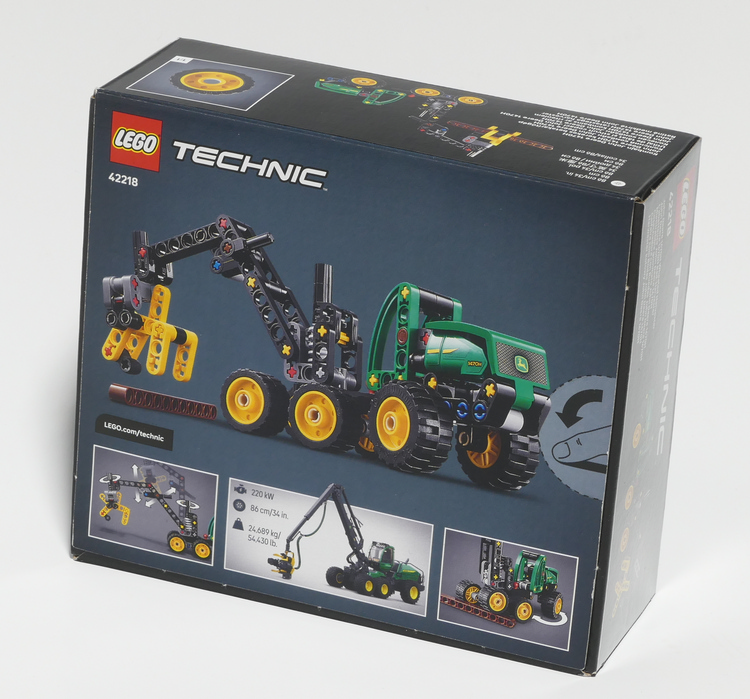
Number of parts: 117
Dimensions: 19 x 12 x 5 cm
Mech.features: Front section wheel bogies, joint between engine and hoist sections, hoist arm with 3 degrees of freedom and a working grabber
33685