
Set Review: 42222 Bugatti Chiron Pur Sport
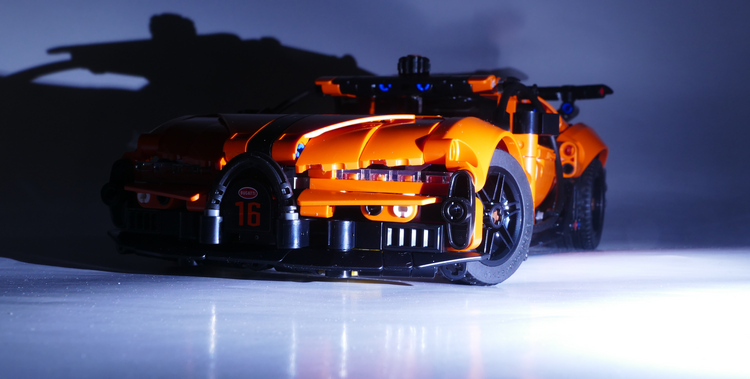
If cars were originally conceived as a practical tool to get their users from their current position to their desired one, supercars must represent the fullest possible antithesis to that principle. They are primarily about speed, about power, about glamour, about headache-inducing prices, and about showing it all clearly for everyone to see.
Maybe, after all, they do get their owners where they wanted to get to very quickly, but that is usually a secondary concern only. Instead, the higher its top speed, the higher the likelihood that a car in question has never even reached half of it, and that it spends its days in its owner's air-conditioned, heavily guarded, humidity-regulated salon, neighboring other such exclusive machines. But we shall skip the usual endless debate between petrolheads and collectors about whether rare cars should be carefully preserved, or enjoyed on road and track.

Any such supercar debate simply cannot happen without mentioning one of the few heavyweights of the game—Bugatti. The company is renowned for its cars regularly setting new world records in all kinds of performance tests, and for its production runs limited so harshly that the likes of Porsche almost seem like generic mass-produced goods in comparison.
Businesswise, Bugatti's path has been as turbulent as the wake behind its cars at full speed. Bankruptcy, revival, ownership changes, wraths and sympathies of its owners—all of that befell the famous brand throughout its history. Nowadays, Bugatti is owned by a joint venture with the majority shareholder being Rimac, an established name in the electric sportscar field, whose headquarters I happen to live only a few kilometers away from.
LEGO's relations with Bugatti are not entirely new: the story began back in 2018 with the huge 3600-part Chiron, a Technic flagship set which introduced a variety of new parts and building techniques, and was supported by major marketing events including a driving LEGO version built in real size. In the meantime there were four other instalments of LEGO Bugattis, and what we got now is the sixth: the Bugatti Chiron Pur Sport.
Compared to the usual Chiron (as bizarre as the adjective "usual" sounds next to a Bugatti model), the Chiron Pur Sport is its special version focused on particularly agile handling, and offering slightly higher performance. This is an old trick of hyper-exclusive car manufacturers: since the production and development capacities are extremely limited and hence the truly new models can be launched only once in a long while, the attention in the meantime is attracted by various special, very special, super-special, extreme-super-special, and ultimate-super-special derivatives of the base model.
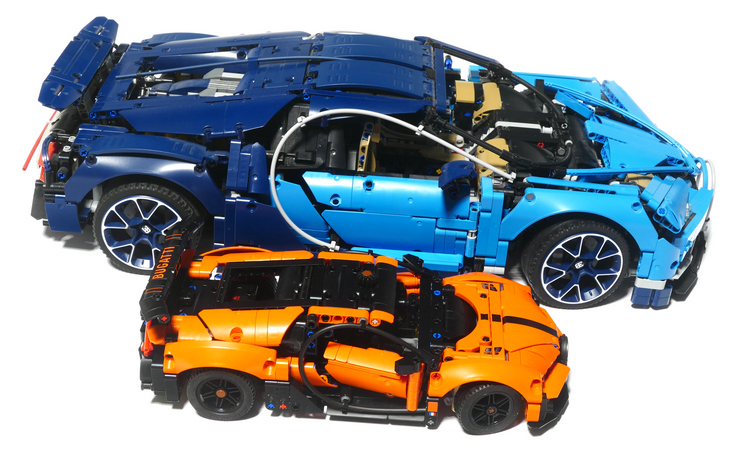
The LEGO incarnation we are reviewing today, the 42222 Bugatti Chiron Pur Sport, is a medium-sized Technic car. Personally, I find the medium size a rather tricky Technic scale to tackle: it is large enough for everyone to expect accurate, precise appearance and interesting mechanical functions, yet too small to allow comfortable full freedom of introducing lots of clever contraptions.
Unboxing is a rather ordinary affair, yielding five numbered paper bags of parts, a single instructions booklet, three hoses, a sticker sheet, and a code that enables the Pur Sport car in the Asphalt Legends game.

However, building this car is not that ordinary. Sure, it does not deviate that much from the usual structure of Technic cars, but there are some interesting techniques one encounters along the way. In order to follow the exact contours of Pur Sport, an entire section at the front is vertically displaced by half a stud, which is not straightforward to accomplish, especially at this scale. Headlights, too, are built at a slight angle allowed by the tiles' size being narrower than a stud by a fraction of a millimeter.
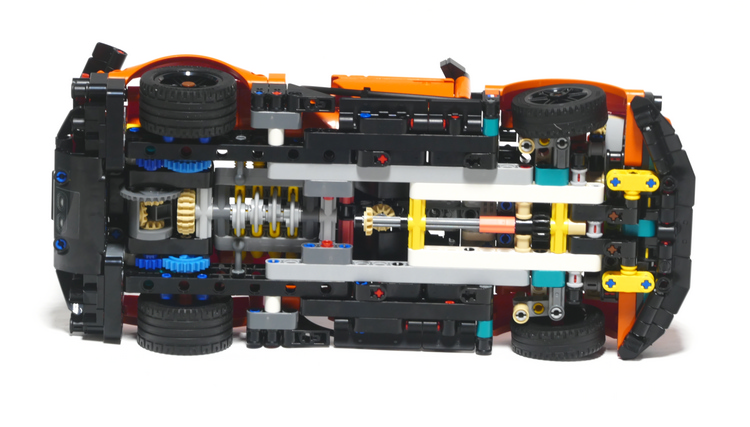
The chassis itself, facing the demand to accommodate a differential and a W16 engine into the limited size predetermined by the scale, employs a trick of offsetting the rear half-axles from the differential using gears and frictionless pins. Such solutions are typically harder to design properly than they may seem: they tend to be fragile, unreliable, and just clunky. In the 42222, however, they work really smoothly.

Even the technique of connecting multiple Technic pins together longitudinally via bars, while not unseen before, is a trick that requires careful design which avoids forces acting to separate them. Same goes for the rear mudguards which are mounted at an angle. As such, the Pur Sport is an interesting little lesson on a couple of intermediate building techniques.
As usual, and probably unavoidably so, there are a few steps where having to position a panel or a fairing of the bodywork at a very specific angle implies a rather finnicky construction of the component supporting it. Fortunately, looking for parts is simplified a lot by their variety of colours, and even more fortunately, those colourful components are not visible once the car is completed. Except from, you guessed it—underneath.

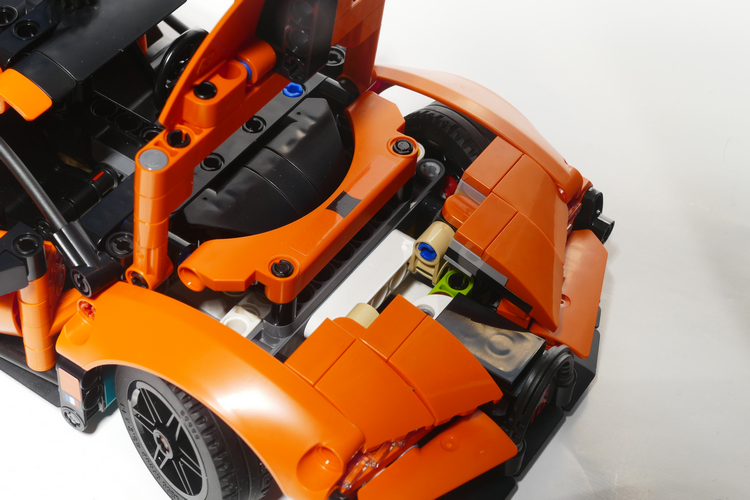
Still, these precise constructions do return the favour, in the form of some very satisfyingly precise shapes. The hood in the front is a particularly nice example of a panel fitting over curved bricks as if it was custom-molded for that exact purpose. Elsewhere in the bodywork, there are some minor slots and holes too, but none is too painful.
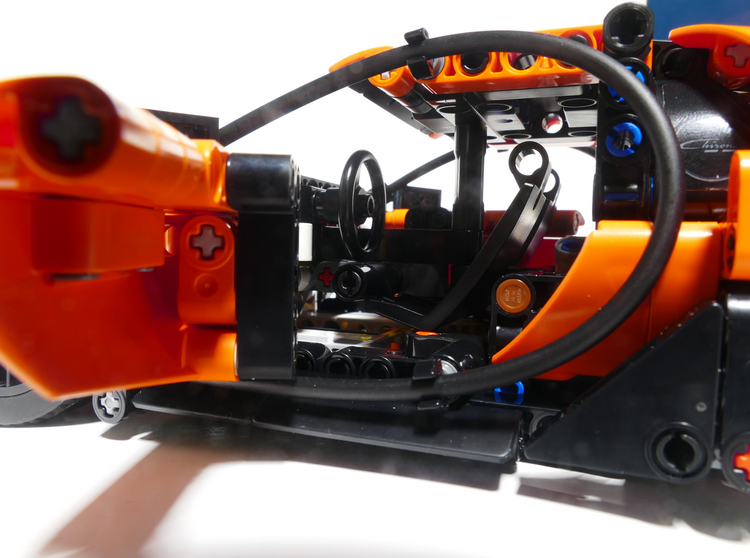
Speaking of which, the iconic Bugattian long and deep curve behind the doors, as well as the slightly curved rear lights, are represented with bent hoses. This is by no means a lazy choice but a rational one, as trying to construct them with solid parts would be likely equally crazy and unrecognizably ugly.
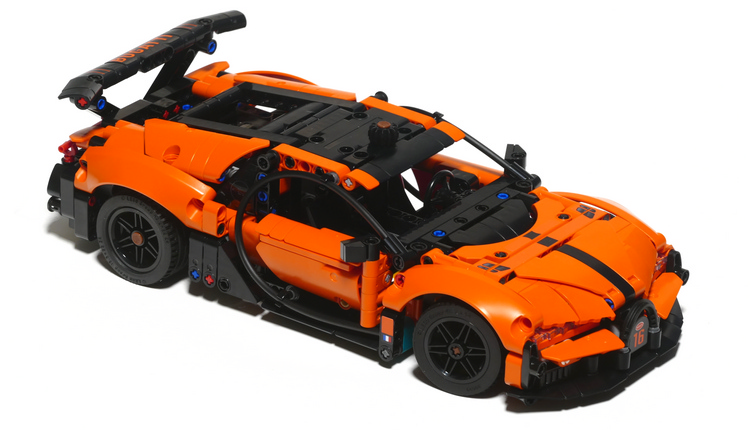
So, once the last part is in place, what do we get? An approximately 1:16 scale Bugatti with openable doors and front hood, a differential, a visible and working W16 engine, and a hand-of-God steering knob on the roof (the steering wheel inside is fixed). In fact, for those preferring fidelity to practicality, building a version without the steering knob is trivially easy: simply omitting the penultimate building step involving one gear and one axle. Not that it makes a huge change in playability because the outer turning circle of this car is approximately 115 centimeters in diameter—but well, this is Technic, so the point is not as much to drive it, as it is to show it can steer.
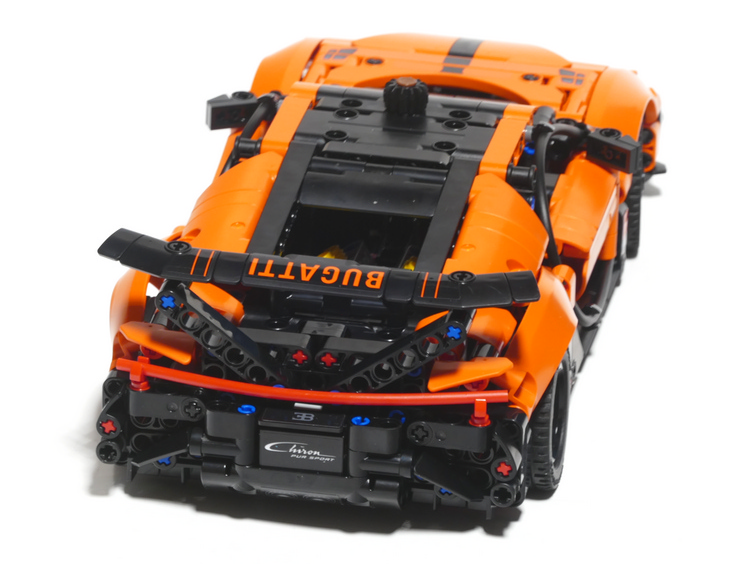
And, to anyone liking sportscars even remotely, this is very clearly and obviously a Bugatti. Even without the Bugatti label on the rear wing, the iconic headlights, the D-shaped front air intake, the contours and the proportions are all very recognizable and, especially within the constrained Technic criteria, the car looks quite good. Observing the sixteen little pistons happily hopping around while one pushes the car along the surface is fun. A snarky purist petrolhead would perhaps note that the front tyres are too narrow, but this is already a step forward from the sets where all four were identical. Besides, wider front tyres would have taken their toll on the already tight steering system and the openable front hood above it, while the improvement would be barely visible.

My main annoyance with this set are its stickers. Do not get me wrong: I am not one of those a priori opponents of stickers nor do I insist on printed parts. To the contrary, I even sometimes find it useful that a sticker can be removed, or not even applied in the first place, and the part used as a generic one. But this car has way too many of them.

Whereas having stickers for the front grille, the little flags on the front mudguards, the rear plate and the large label on the rear wing would have been the perfect sweet spot, there are eight other, smaller stickers for the stripe on the front hood, for the engine, for the extra air intakes, for the exhaust, and for the lines on the rear wing. In my view, not only do these not contribute much, but in the case of air intakes they are multi-segment and span multiple parts, which makes the model plain uglier. Also, the stickers on the rear wing are applied to a convex surface, meaning that the risk of them peeling over time is higher—and I cannot fathom who would truly miss these four thin orange lines if they weren't there. Had I not wanted to build the exact model for the purpose of this review, I would have happily left them alone on the sticker sheet.
To be fair to LEGO, perhaps this is not their fault, but rather the case of Bugatti forcing their hand. Having already been subjected to similar situations in my experience (unrelated to LEGO), I can imagine a very strict and uncompromising representative of Bugatti absolutely insisting on the car having these ugly intakes and irrelevant wing lines to differentiate the Pur Sport as much as possible from the regular Chiron, although the share of buyers who know and care for the difference could be conveniently measured in the unit of "parts per million".

All this does not exonerate the bizarre choice of taking a black part and applying a sticker with an orange cover to it, while the orange part would have done a stellarly better job. This was possibly a cost-cutting measure.
While this car undoubtedly will find its place on many display shelves, there will be others who will just as zealously disassemble it. Viewed from the parts supply angle, much of its 771 parts are fairly standard and useful Technic building material, with a large share of it being in a common and versatile colour—black. As for the rarer orange, there is obviously a fine supply of various panels, but probably not in the amount which alone would allow you purely orange projects. Speaking of colours, I did not spot any worrying mismatches in the shades of orange between the parts, but there are builders who certainly have better eyes for the finest of shades than I do.
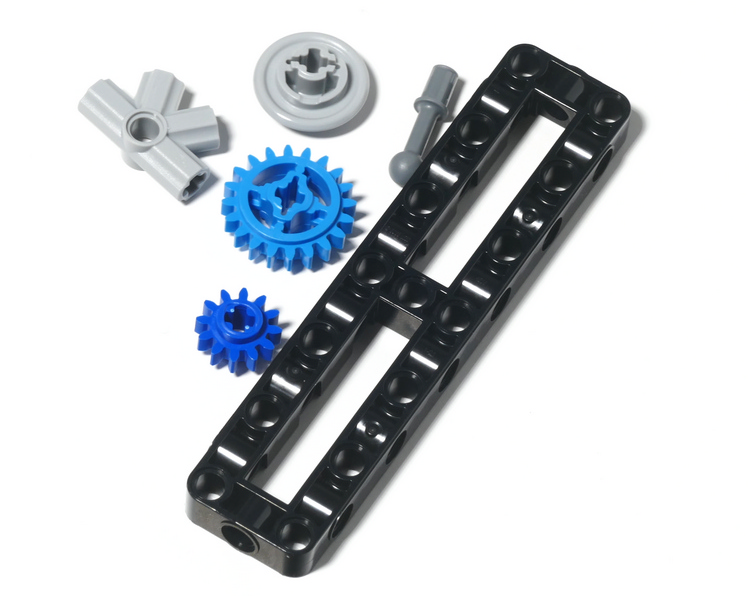
Additionally, hunters for the interesting new or at least recent Technic parts will find a share of them, too. The set includes two new trianguar plate connectors (6613) which appeared in 2025 and have been seen in black only in the Volvo Excavator so far. The quadruple axle connector (6611), which also newly appeared in 2025, makes its dual appearance here, too. Of interest is also the relatively recent 3x13 black frame (4526) as well as the still new small Technic pistons (4369) of which there are sixteen here, along with their four crank discs (4368). The 20-tooth (69779) and 12-tooth (69778) spur gears aren't that new anymore, but can be an additional incentive to procure this set.
The instruction booklet and the building steps themselves, if I can give an indirect compliment here, are of the usual quality—that is, pretty good. From the 233 required steps, no complaints: even if I had to squeeze a remark, the best I could find was one single step that could have theoretically benefited from a better viewing angle, and even that one will not keep any experienced builder wondering for more than half a second. No superhuman dexterity was required, either.
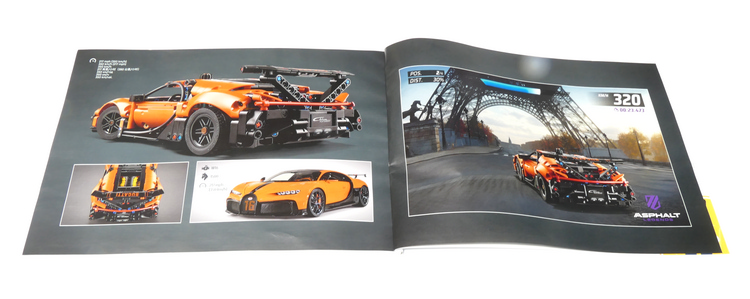
Some sets based on real objects sometimes go to considerable lengths to present the topic (an example that comes to mind outside Technic is the Fender Stratocaster!), some not, and the Pur Sport sits somewhere in the middle. At the end of the booklet there is a two-page gallery with a few photos and selected technical data, but no text on the Pur Sport version nor the Chiron in general.

Overall thoughts? The 42222 set deserves a thumb up, without much hesitation. Like I mentioned, medium scale Technic cars are far from an easy playing field, and designing them well requires a combination of many skills. It is recognizable, not too difficult to build nor too trivial in terms of functionality, and can serve as an example of a fine mid-sized Technic set. Luckily, its main drawback, which to me are its stickers, is the easiest one to solve—by omitting the heaviest offenders. Its other drawbacks are not difficult to live with, and are offset by the set's strengths.
As far as the price is concerned, which is announced at the time of writing to hover around 65 € when the set hits the shelves, it is a fairly average one for this particular series of mid-sized Technic sportscars where it enjoys (or will enjoy) the company of a Ferrari, Ford, Porsche, Toyota, Aston Martin, BMW, Corvette, Lamborghini, Koenigsegg, and also another Bugatti. Nothing wrong with this set as such, but it may simply be difficult to distinguish in this ever-increasing, medium-sized, 700-to-800-parts, crowd of licensed fast cars.
We thank the LEGO Group for giving us this set for a review.
Number of parts: 771
Dimensions: 29 x 13 x 8 cm
Mech.features: Working W16 engine with a differential, HoG steering, openable doors, openable front hood
Additional content/items: A code for Asphalt Legends


33684